Here Is the Machine Under the Hood
Wika looks friendly and feels simple. That is intentional. But underneath the warm colors and the cheerful interface is a carefully designed learning system built around one goal: making regional Philippine language learning stick, for real, in the long run.
The Three Core Components
Lessons, Dialecto AI, and personalized onboarding, working together.
The Lesson Loop
The same five steps in every Wika lesson, from kumusta to recap.
Step 1: Kumusta
Every lesson opens by telling you what you will be able to do by the end, with a quick warm-up question. Then the Wika mascot sets the scene in a short conversation and introduces the new words you are about to learn.
You meet the words in context first, inside a moment you would actually find yourself in, before anyone asks you to produce them.
Step 2: Reviewer
The Reviewer walks you through the lesson's words and phrases one card at a time, each with native-speaker audio you can tap to replay and an English meaning underneath.
It is a study moment, not a test. Nothing is scored yet, so you can take your time and listen as often as you need.
Step 3: Practice
Now you use what you just studied. Practice mixes formats: multiple choice, fill in the blank, building sentences from word blocks, listening and picking what you heard, matching pictures and pairs, and saying phrases out loud.
Practice is scored, and a wrong answer costs a heart. Switching formats keeps you recalling the same words in different ways instead of memorising one screen.
Step 4: Scenario
The Scenario puts you inside a real-life Filipino situation with a goal to reach, like ordering at a carinderia or answering a message from a lola. You write your own reply, then compare it with a sample turn.
A short reflection task follows, so you put the lesson's words into your own sentences before you leave.
Step 5: Recap
Every lesson ends with a recap of the words you learned and a preview of what comes next, then your XP and streak update on the home map.
Seeing exactly what you learned, and what is up next, is what turns one lesson into the habit of coming back for the next.
Dialecto: Your Conversational AI Practice Companion
The friend who is always available, always patient, and always rooting for you.
What Dialecto Does
Dialecto holds open-ended conversations with learners in their target language. You type or speak to Dialecto, and it responds naturally. When you make an error, Dialecto gently notes the correction and continues the conversation without making you feel bad about it.
Why Dialecto Matters
The number one reason people stop practicing a new language is fear. Dialecto eliminates all of that. Every conversation is private, judgment-free, and available at any time. By the time they have a real conversation with a native speaker, they have already had dozens of low-stakes practice runs.
Not a Replacement for Human Connection
We are very clear about this. Dialecto is a practice space, not a destination. Its job is to lower the barrier to entry for real conversations, not to replace them. After a few weeks with Dialecto, learners should be more ready to initiate real exchanges with native speakers.
Dynamic Onboarding: A Learning Path Built Around You
Most language apps start everyone at the same place. Wika does not.
How Dynamic Onboarding Works
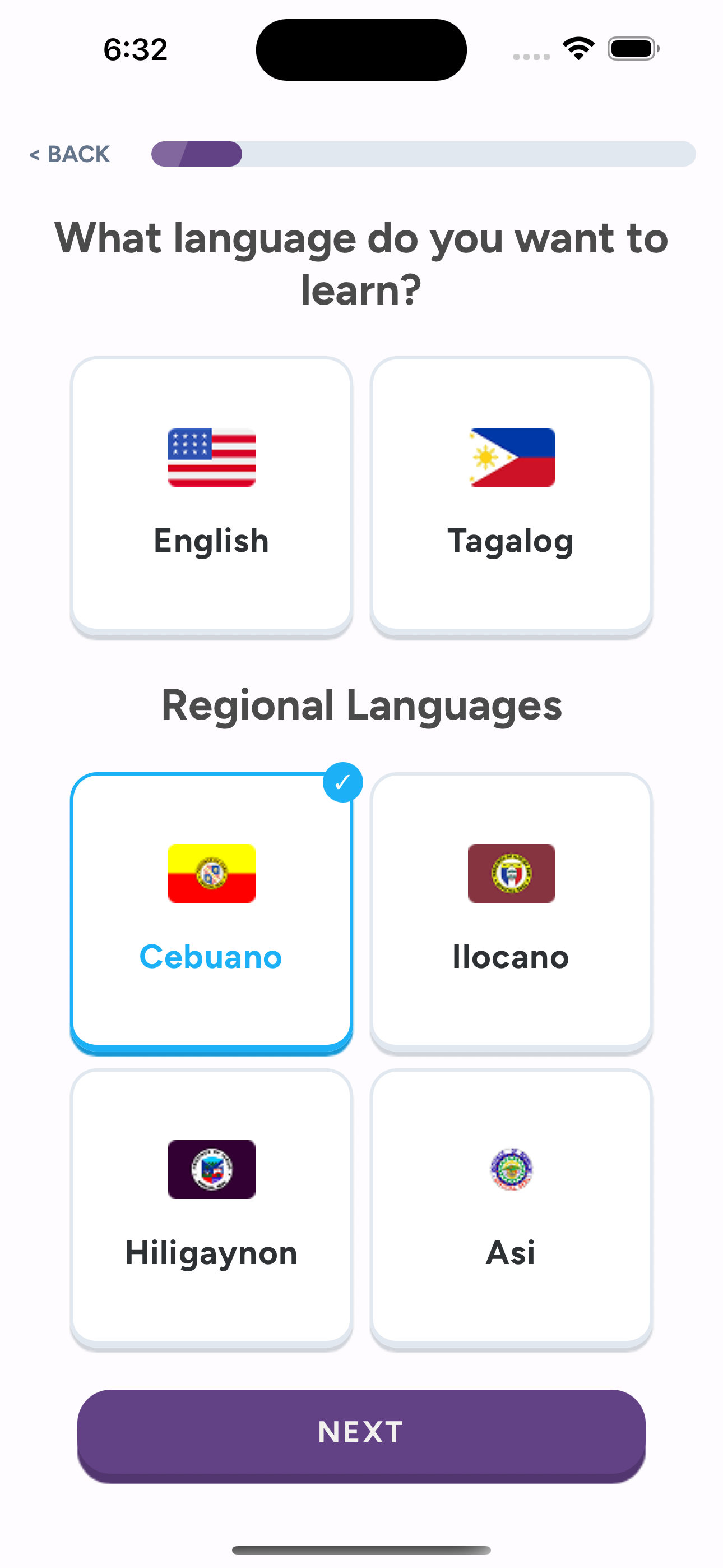
When a new learner sets up their Wika account, they complete a short, conversational onboarding sequence. The sequence collects four key data points:
Background Origin
Where are you from, or where is your family from? Regional heritage context changes which vocabulary and cultural references are most relevant.
Current Status
Are you a complete beginner, a heritage speaker with passive knowledge, or somewhere in between? This determines your starting proficiency placement.
Goals
Are you learning to communicate with family, prepare for a work assignment, study linguistics, or reconnect with a cultural identity?
Baseline Proficiency Test
A short, practical assessment that measures what vocabulary and structures you already recognize and produce.
The Result
A heritage Cebuano speaker who grew up hearing the language but never formally learned it starts somewhere completely different from a Manila-based professional who has never heard a word of Cebuano. Both will reach the same milestones, but by paths that actually match where they started. No learner is bored. No learner is lost. That is the entire point.
The Technology Behind Wika
Wika is a mobile-first application built on React Native and Expo, which means it runs natively on both iOS and Android from a single, well-maintained codebase. This is not a web app wrapped in a mobile shell. It is a genuinely native mobile experience.
Dialecto is powered by a modern large language model, instructed to behave like a patient language practice partner. It is not a generic chatbot. It is built specifically to support the social and linguistic dynamics of heritage language practice.
Our content pipeline combines machine-assisted draft generation with mandatory human validation. Every lesson goes through review by both academic linguistics consultants and native speaker community validators before it reaches a learner.
See the Platform in Action
The best way to understand Wika is to use it. Download it on the App Store or Google Play and try all three components yourself.
Ready to Find Your Voice?
Wika is live on the App Store and Google Play — download it free and start speaking like a local today!




Ready to Find Your Voice?
Wika is live on the App Store and Google Play — download it free and start speaking like a local today!